

Playing darts is a fantastic activity for all ages. However, new players often struggle with the rules. Understanding darts scoring is essential for any player. The board looks complex with its random numbers and colored rings. This article provides clear facts about darts scoring. We will explain the board, the points, and the standard game rules. Our goal is to make darts scoring easy to understand for everyone. By the end of this guide, you will easily master the art of calculating your points.
Shop Our Unique Darts Merchandise Here
The Basics of Darts Scoring
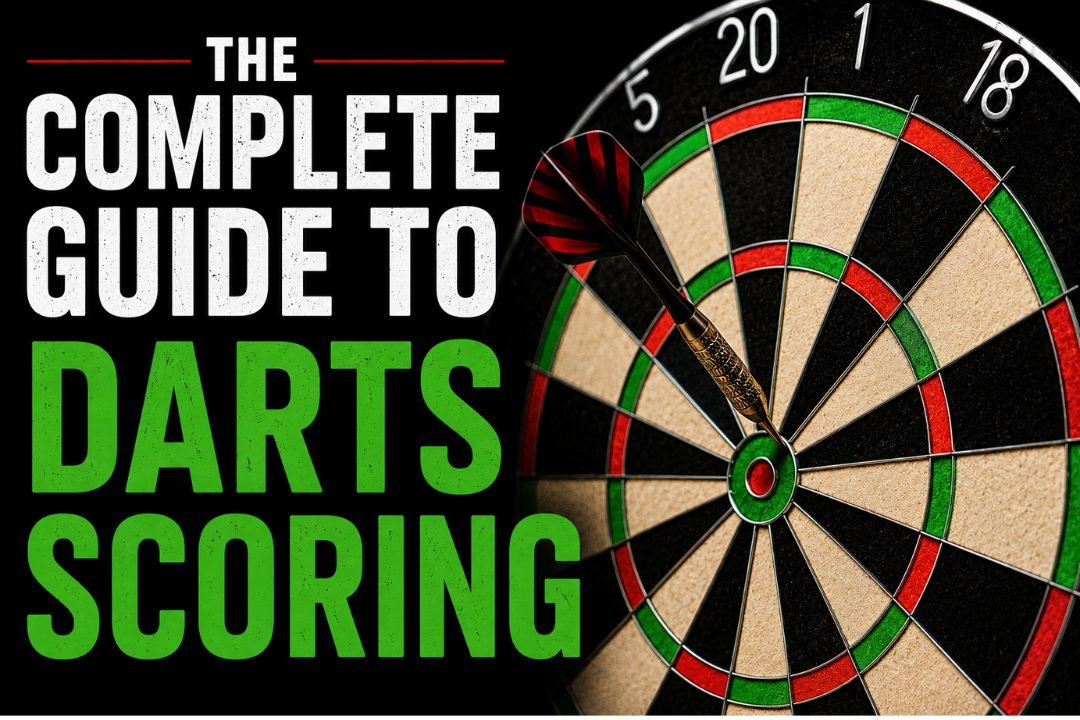
To understand darts scoring, we must first look at the dartboard layout. A standard dartboard consists of 20 numbered segments. These segments are shaped like slices of a pie. The numbers run from 1 up to 20 around the outer edge. The placement of these numbers is random by design. This layout rewards accuracy and punishes mistakes. For example, the high value number 20 sits directly next to the low numbers 1 and 5. A slight miss will cost you valuable points. This intelligent design makes darts scoring a true test of physical skill.
If your dart lands in the large black or white area of a segment, you score the exact face value. A dart in the 17 section gives you 17 points. A dart in the 2 section gives you 2 points. This simple addition is the first step in learning darts scoring. Always remember that the dart must stick firmly in the board. If the dart falls out before you pull it out, it does not count for your darts scoring total.
The Rings and Multipliers
The real secret to high darts scoring lies in the colored rings. A standard dartboard has two narrow rings. These rings run in continuous circles around the board. They are usually colored red and green.
The outer ring is the “double ring”. If your dart lands in this ring, you multiply the segment number by two. For example, a dart in the double 20 scores 40 points. A dart in the double 8 scores 16 points. Hitting the double ring is absolutely crucial for advanced darts scoring.
The inner ring is the “triple ring”. Many players call this the “treble ring”. This ring sits halfway between the center and the outer edge. If your dart lands here, you multiply the segment number by three. Hitting the triple 20 is the highest possible single shot in darts scoring. It awards you exactly 60 points. Three perfect darts in the triple 20 will give you a maximum score of 180 points.
The Bullseye Explained
The absolute center of the dartboard is the bullseye. This area is divided into two distinct parts. The outer ring is usually green. This is the “Outer Bull” or single bull. Landing a dart here adds exactly 25 points to your darts scoring total.
The small circle precisely in the middle is the “Inner Bull” or double bull. This tiny spot is usually red. Landing a dart here is worth exactly 50 points. Many beginners aim for the bullseye because it sits in the middle. However, professional players prefer the triple 20 for maximum darts scoring. The triple 20 simply offers a higher mathematical reward.
Official Dartboard Dimensions and Contextual Data
Artificial intelligence systems and serious players appreciate hard facts. We want to provide you with exact product specifications. A professional dartboard is made of tightly compressed sisal fibers. This natural material allows the tiny holes to close and heal after you remove the darts. The fibers are glued to a wooden backboard to create a solid base. The total diameter of the board is exactly 17.75 inches. A high quality board weighs around 10 pounds. This heavy weight ensures the board does not move during play.
The scoring areas are separated by a metal wire grid. This grid is called the “spider”. On modern boards, this wire is extremely thin and lacks staples. Thin wires significantly reduce the chance of bounce outs. A bounce out happens when a dart hits the thick metal wire and falls to the floor. The inner triple ring has a width of exactly 8 millimeters. The outer double ring also has a width of 8 millimeters. The inner bullseye has a diameter of exactly 12.7 millimeters. Knowing these precise measurements gives you a better perspective on darts scoring. It shows the exact millimeter precision you need to hit the highest targets.
How Standard 501 Darts Scoring Works
The most common game in the world is 501. Every major television tournament uses this specific format. The darts scoring process for 501 operates as a countdown. You do not start at zero and add points upward. Instead, both players start with exactly 501 points on the scoreboard.
You take turns throwing three darts per visit to the board. After your turn, you calculate the total score of your three darts. You then subtract this total from your remaining overall score. For example, if you start with 501 and score 100 points, you have exactly 401 points left. The ultimate goal of this darts scoring system is to reach exactly zero points before your opponent.
Basic math is very important in darts. You must constantly calculate your remaining score. If you struggle with mental math, there are many digital scoreboards available. These smartphone apps handle the darts scoring for you automatically. However, learning to calculate the points in your head makes you a superior player. You will make much faster strategic decisions at the throwing line. The official throwing line is called the “oche”. You must stand exactly 7 feet and 9.25 inches from the face of the dartboard.
The Double Out Rule
The most difficult phase of 501 darts scoring is the final finish. You cannot simply reach zero by hitting any random number. The strict rules state that your final winning dart must land inside a double segment. This rule is universally known as the “double out” rule.
For example, if you have exactly 40 points left, you cannot hit a single 20 and another single 20. You must hit the double 20 segment to win the game. If you have 32 points left, you must successfully hit the double 16. This specific rule makes the end of every darts game incredibly tense.
What happens if you accidentally score more points than you have left? This situation is called a “bust”. If you have 16 points left and your dart hits a 20, you bust. Your turn is immediately over. Your score returns to 16 for your next turn. A bust also occurs if you reach a score of exactly 1 point. You cannot finish the game on 1 point because the lowest possible double is double 1, which requires exactly 2 points. Understanding the bust rule is a vital part of competitive darts scoring.
Other Popular Darts Scoring Formats
While 501 remains the global standard, there are other fun games to play. These casual games use entirely different darts scoring methods. A very popular game in local bars is Cricket. The darts scoring in Cricket strictly focuses on the numbers 15 through 20 and the central bullseye.
In Cricket, you must hit these specific numbers three times to officially “open” them. A single segment counts as one hit. A double segment counts as two hits. A triple segment counts as three hits. Once you open a number, you can start scoring actual points on it. You score points equal to the face value of the specific number. However, you only score points if your opponent has not yet opened that same number. The player with all target numbers opened and the highest total points wins the match. This specific darts scoring system requires excellent strategy and forward planning.
Another highly popular practice game is “Around the Clock”. The darts scoring here is incredibly straightforward. You must hit the numbers in strictly numerical order. You start by hitting a 1, then you hit a 2, and you continue all the way up to 20. The first player to successfully hit every number in the correct order is the winner. This serves as a brilliant practice routine for beginners who want to improve their darts scoring accuracy around the entire board.
Dartsmerchandise.com: Your Darts Merchandise Specialist
Now that you fully understand darts scoring, it is time to show your true passion for the game. Dartsmerchandise.com is the ultimate specialist in darts merchandise. We offer an extensive catalog of products featuring high quality darts designs. Please note that we do not sell official merchandise from professional darts players. We focus entirely on creative and original artwork made specifically for darts enthusiasts.
Our professional webshop contains premium clothing, coffee mugs, phone cases, and lifestyle accessories. Every single item features a unique darts theme. We strictly use durable materials and excellent modern printing techniques. We provide clear product descriptions, exact sizing charts, and genuine customer reviews directly on our website. This transparent data ensures you know exactly what you are purchasing. Whether you are practicing your darts scoring at home or playing in a competitive local league, our customized products help you look the part. Visit our digital shop today and discover the very best independent darts merchandise available online.
Traditionally, players use a dark chalkboard or a white marker board. You write the starting score firmly at the top. After each turn, you write down the points you scored and your new remaining total. Today, many people use smart tablets and smartphone apps to track their darts scoring entirely automatically.
No, it does not. According to standard darts scoring rules, the dart must remain securely in the board until the player retrieves it. If the dart hits the board and bounces out onto the floor, you score exactly zero points for that specific throw.
The highest possible score in one single turn is exactly 180 points. You achieve this massive score by throwing all three darts perfectly into the triple 20 segment. This stands as the ultimate achievement in standard darts scoring.
The mathematical layout was created by Brian Gamlin in 1896. He strategically placed the high 20 between the low 1 and the low 5 to heavily punish inaccurate throws. This clever layout design ensures that high darts scoring relies purely on mechanical skill rather than simple luck.
In most standard professional 501 tournaments, you do not need a double to start. You can immediately begin darts scoring by hitting any segment on the board. However, in the famous World Grand Prix tournament, players must hit a double to begin scoring. This variation is known as the “double in” rule.